
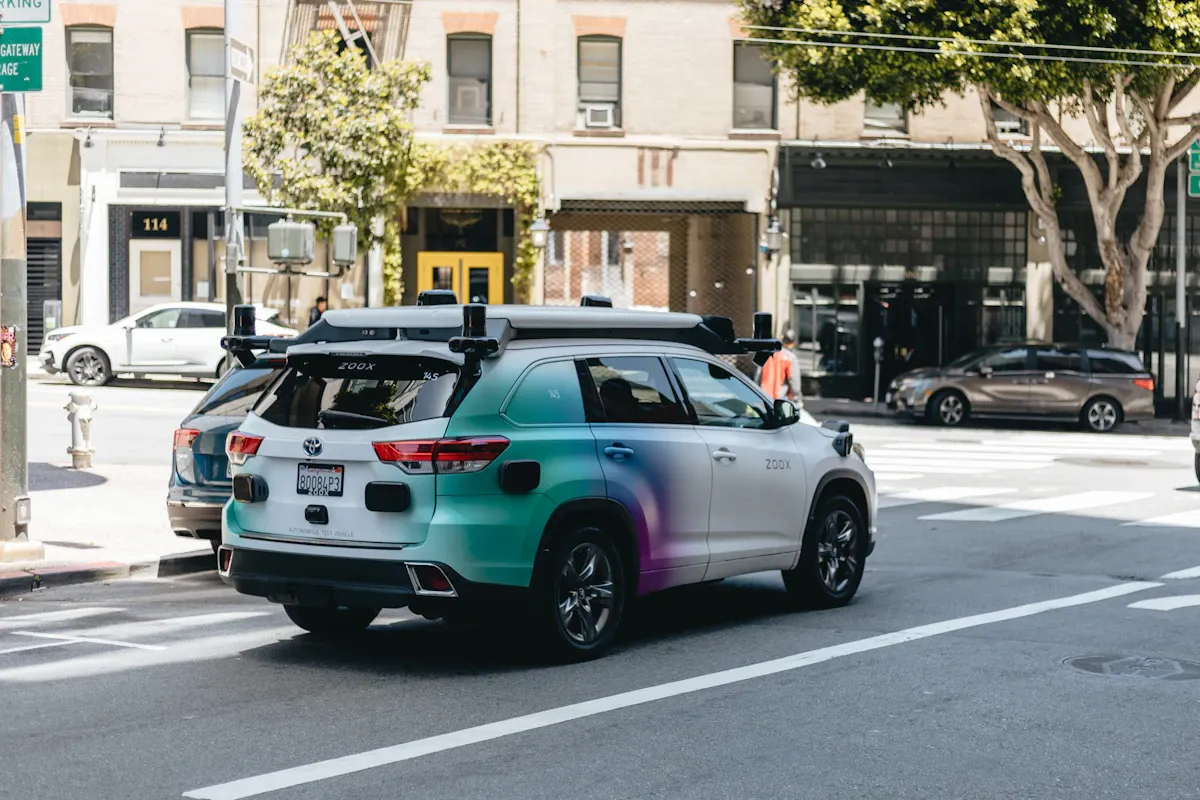
Fifty years ago, nobody worried about getting carsick while reading in the back seat, because the driver was watching the road and you knew it. Today, that simple social contract is breaking down, and your stomach is the first to notice.
Why Motion Sickness Happens in Self-Driving Cars
Think about the last time you read a text message in a moving car. That slight nausea you felt? That is your body sounding an alarm.
Here is what happens. Your eyes see a stationary phone screen. Your inner ear, which handles balance, feels the car accelerating and turning. Your brain receives two completely different stories about what your body is doing. When those signals conflict, your brain assumes one of them must be wrong. And historically, the most likely explanation for that kind of sensory confusion was poisoning. So your brain triggers nausea, the first step in making you throw up whatever toxin it thinks you swallowed.
This is called the sensory conflict theory, and it has been the dominant explanation for motion sickness since the 1970s. It perfectly explains why looking out the window helps. When you watch the road, your eyes and your inner ear finally agree.
Now apply this to a self-driving car. In a regular car, you can see the steering wheel move. You can anticipate turns because you watch the driver's hands. Your brain gets a preview of what is about to happen. In an autonomous vehicle, that preview disappears. The car just moves. You have no visual warning before a turn, a lane change, or a sudden brake. University of Michigan researchers have identified this loss of anticipatory information as a key reason passengers in self-driving cars experience higher rates of motion sickness. As one research professor put it, in autonomous cars everyone will be a passenger, so the protection that drivers naturally receive from watching the road will no longer be there.
Electric vehicles make this whole problem worse. EVs deliver instant torque, meaning the car can accelerate sharply without the gradual buildup you feel in a gas-powered car. There is no engine vibration, no gear shifting, and no sound cue that a change in speed is coming. Research published in the International Journal of Automotive Technology has examined motion sickness prediction in electric vehicles under real-world driving conditions, finding that the unique acceleration profiles of EVs create distinct sensory conflicts for passengers that require specialized prediction models rather than adaptations from gas-car data.
So you have a perfect storm. No driver to watch. No engine sounds to prepare you. Instant, silent acceleration. Your brain never knows what is coming next.
Why It Matters for the Future of Autonomous Driving
This is not a minor inconvenience. It could determine whether self-driving cars actually succeed.
Think about what autonomous vehicle companies are selling. They promise productivity. You will work during your commute. You will watch movies. You will sleep. The entire business model depends on passengers doing things other than staring at the road. But if doing those things makes you sick, the value proposition collapses entirely.
Surveys of potential autonomous vehicle users consistently show that motion sickness ranks among the top concerns, alongside safety and cost. People are not excited about a robot taxi if it means arriving at their meeting feeling like they need to lie down.
The automotive industry has invested heavily in autonomous driving technology. But all of that investment hits a wall if the passenger experience is physically unpleasant. You can build the most sophisticated AI driver on the planet, and it will not matter if nobody wants to ride in it for more than fifteen minutes.
The Vestibular System Does Not Care About Your Commute
Your vestibular system, the tiny organ in your inner ear that manages balance, evolved over millions of years. It was never designed for a world where you sit still while the environment around you moves at highway speeds. You cannot logic your way out of motion sickness. You cannot tell your brain to stop reacting because the technology is impressive.
This biological reality means that solving motion sickness is not just a software problem. It is a human factors problem. Engineers have to design around the limitations of the human body, not just optimize the driving algorithm.
Some companies have tried simple fixes. Larger windows. Reclining seats. Screens that show the car's planned path so passengers can anticipate movements. These help, but they are Band-Aids. They reduce the problem without solving it.
The Fix Researchers Are Building
The real solution looks very different, and it starts with rethinking the relationship between the car and the passenger's senses.
A team of researchers from Japan's Nara Institute of Science and Technology recently tested a system that presents the driving path to passengers before the car moves. Instead of just showing a map, the system uses visual path cues that let passengers see exactly where the vehicle is about to go. In a controlled experiment with 16 participants, providing path information significantly reduced motion sickness scores and delayed the onset of symptoms. The key insight: passengers who could see the planned path were more likely to naturally align their head movements with the direction of the vehicle's rotation, giving back that anticipatory signal you get from watching a human driver.
University of Michigan researchers took a different approach. They developed and patented a system that uses light stimuli in the passenger's visual periphery to mimic what they would see outside the vehicle. The idea is to eliminate the conflict between vestibular and visual inputs without requiring the passenger to look out a window. The patent covers both wearable and vehicle-based versions of the technology, and the team is now working to commercialize it with automakers.
There is also work happening on the driving algorithm side. Instead of programming autonomous cars to drive as smoothly as possible, which sounds good in theory but can actually feel unnatural and unpredictable, some researchers are teaching cars to drive more like humans. Slightly imperfect. Slightly anticipatory. A human driver eases into a brake. An AI might brake with mathematical precision but zero warning. That precision feels harsh to your inner ear.
The EV-specific research adds another layer. Because electric vehicles have distinct acceleration characteristics, future autonomous EVs might have personalized driving profiles. If the system knows you are prone to motion sickness, it could automatically adjust acceleration curves and braking patterns to match your tolerance.
All of these approaches share a common thread. They stop treating the passenger as cargo and start treating them as part of the system. The car does not just drive itself. It drives in a way that your body can understand.
What This Means for Your Next Ride
The first generation of robotaxis already exists on streets in a handful of cities. Passengers report mixed experiences. Some love it. Others feel queasy after ten minutes. The companies running these services know about the problem, and they are quietly working on it.
Over the next few years, you can expect to see more vehicles equipped with passenger-facing displays that show the car's intended path. You will see seats designed to reduce vestibular conflict by positioning your body at specific angles. You will see driving algorithms that prioritize passenger comfort over raw efficiency.
The goal is not to eliminate motion sickness entirely. That is probably impossible for some people in some conditions. The goal is to reduce it enough that most passengers can read, work, or watch a screen during a thirty-minute ride without feeling miserable.
That is the threshold that matters. If the industry can clear it, autonomous vehicles become genuinely useful for daily life. If they cannot, self-driving cars might end up being great for freight and short hops but impractical for the kind of long, productive commutes that companies keep promising.
Your vestibular system is ancient, stubborn, and deeply unimpressed by artificial intelligence. But the engineers trying to outsmart it are getting closer. The question is whether they can get there fast enough to keep the autonomous revolution on schedule. What would you actually do with your commute time if you knew you would not feel sick?
Comments