
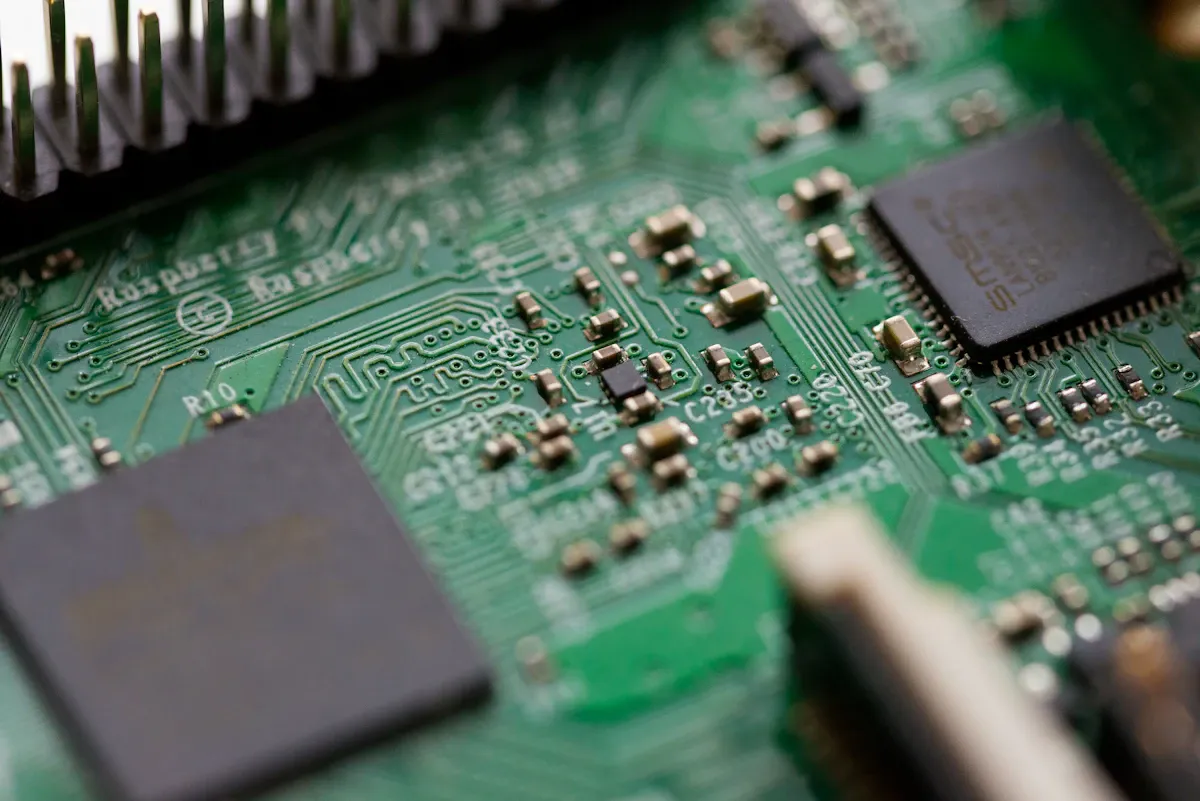
Intel Loihi 2 processors, part of a neuromorphic hardware market projected to reach $14.90 billion by 2032, trace their design philosophy back to a simple question asked over four decades ago: what if computer chips worked like actual brains instead of calculators? That idea, once dismissed as a lab curiosity, is now the foundation of a hardware race with serious money behind it.
What Neuromorphic Hardware Actually Is
Traditional chips, even the ones running massive AI models today, still follow a basic script invented in the 1940s. They fetch data from memory, process it through a central unit, and write results back. This back-and-forth burns enormous energy, especially for AI workloads that involve billions of simple calculations.
Neuromorphic hardware flips that approach entirely. Instead of shuttling data around, these chips place tiny computational units directly inside the memory. Each unit mimics a biological neuron. They communicate through spikes, brief electrical pulses, rather than continuous numbers. A neuron fires only when it receives enough input, then goes quiet again. This on-demand behavior is the core reason these chips sip power compared to traditional processors.
The technology comes in a few flavors. Most current chips use standard CMOS fabrication but arrange the transistors to behave like spiking neural networks, or SNNs. The real leap sits in emerging components like memristors. A memristor is a circuit element that remembers how much charge has passed through it. That memory-like behavior maps almost perfectly onto how biological synapses strengthen or weaken over time. Several research teams are building chips where memristors handle both computation and storage in a single physical device, eliminating the energy-hungry data shuttle entirely.
The Market Numbers Behind the Boom
So why is this happening now? The short answer is that traditional AI hardware is hitting a wall, and investors see neuromorphic chips as a plausible way through it.
The neuromorphic hardware market was valued at roughly $2.80 billion in 2025, according to Coherent Market Insights. That is not pocket change for a category that barely had commercial products five years ago. But the forecast is what turns heads. Analysts project the market will grow to $14.90 billion by 2032, a compound annual growth rate of 25.5%. That pace is usually reserved for technologies in the earliest stages of adoption.
Multiple independent market analyses line up on the direction, even if exact figures vary. AnalystView Market Insights valued the market at about $2.57 billion in 2024 with strong growth projected through 2032, driven by demand for edge AI and low-power inference. GM Insights points to the same trajectory, noting that the push comes from sectors that cannot afford the power budgets of data center GPUs. And Verified Market Research separately confirms growth expectations for the broader neuromorphic computing category, with edge deployment cited as the primary commercial pull.
Where the Money Is Flowing
The market breaks down into distinct hardware components. Processors make up the core, but sensors, supporting hardware, memory modules, and specialized software stacks each claim their own share. This matters because it signals a maturing ecosystem. A chip without software is useless, and a processor without compatible sensors cannot interact with the physical world.
By technology type, CMOS-based neuromorphic chips dominate current revenue because they can be manufactured in existing semiconductor foundries. Memristor-based designs sit further out but attract heavy research funding because they promise orders-of-magnitude improvements in energy efficiency.
Why Spiking Neural Networks Change the Rules
The software side deserves attention because it is tightly coupled to the hardware story. Most AI today runs on artificial neural networks that process dense arrays of numbers. Spiking neural networks, the software counterpart to neuromorphic hardware, work differently.
Instead of passing floating-point numbers between layers, SNNs pass discrete spikes. A spike either fires or it does not. This binary nature maps beautifully onto the event-driven hardware. If no input is changing, no neurons fire, and the chip barely uses power. For applications like always-on voice monitoring, security cameras, or vibration sensors on industrial equipment, this is a massive advantage.
Traditional deep learning models can be converted to run on neuromorphic hardware, but the efficiency gains are modest. The real performance jump comes when researchers design SNNs from scratch, training them to leverage temporal dynamics, meaning the precise timing of spikes carries information, not just the spike rate. This is closer to how your auditory cortex distinguishes between a doorbell and a fire alarm.
Intel has been one of the most visible players here with its Loihi and Loihi 2 research chips. Loihi 2 introduced configurable neuron models, letting researchers tune the chip to match different SNN architectures. IBM, BrainChip, SynSense, and GrAI Matter Labs each have their own approaches, targeting different application niches from autonomous drones to smart wearables.
The Hard Problems Nobody Solved Yet
Before you assume brain-like chips will replace GPUs overnight, understand the gaps.
Training spiking neural networks is still notoriously difficult. The spike function is not smoothly differentiable, which breaks the backpropagation algorithm that made deep learning explode in the 2010s. Researchers have developed workarounds like surrogate gradient methods, but training SNNs remains slower and less reliable than training conventional networks. You cannot simply take a ResNet-50 model, slap it on a neuromorphic chip, and expect magic.
Accuracy on standard benchmarks also lags. SNNs have closed the gap on tasks like image classification and keyword spotting, but they still trail conventional deep learning on complex tasks involving language, reasoning, and generative output. The hardware is ahead of the software in many respects.
Manufacturing is another constraint. Memristor-based chips face reliability issues. The devices drift over time, meaning a synapse that starts at a certain weight may slowly shift. Researchers are developing compensation algorithms, but this adds complexity that commercial customers do not want to deal with.
Then there is the ecosystem problem. PyTorch and TensorFlow have millions of developers. Neuromorphic frameworks like Intel's Lava or MetaTF serve a few thousand researchers at best. Until the tooling improves, adoption will stay confined to well-funded labs and specialized defense or industrial contracts.
Where This Actually Gets Used
Despite the challenges, neuromorphic hardware is already running in real environments, just not in the places most people look.
Edge computing is the natural fit. A drone carrying a neuromorphic vision processor can detect and avoid obstacles while drawing milliwatts instead of watts. That translates directly into longer flight time. Industrial vibration sensors using spiking networks can detect bearing failures in real time on a single battery charge that lasts months, not days.
Autonomous vehicles represent a longer-term target. Self-driving systems need to process multiple sensor streams simultaneously with strict latency and power budgets. Several automotive companies have partnered with neuromorphic startups to explore whether SNNs can handle the always-on perception layers, leaving conventional chips to handle the higher-level planning tasks.
Defense applications are also driving funding. The U.S. Department of Defense has funded multiple neuromorphic programs through DARPA and other agencies, attracted by the combination of low power, low latency, and resistance to adversarial attacks. Spiking networks are inherently harder to fool with carefully crafted pixel perturbations because their binary, temporal processing does not respond to the same vulnerabilities as conventional networks.
What Happens Next
The next five years will likely determine whether neuromorphic computing becomes a mainstream category or remains a niche for edge AI and defense.
The key inflection point is not a better chip. It is better software. If the research community cracks the training problem, producing SNNs that match or exceed conventional networks on standard benchmarks while using a fraction of the energy, the hardware demand will follow. The market forecasts suggesting $14.90 billion by 2032 are essentially betting that this software progress happens on schedule.
Memristor technology will also play a decisive role. If foundries can produce reliable, consistent memristive devices at scale, the energy efficiency story gets dramatically stronger. If not, CMOS-based designs will carry the market, growing steadily but without the step-change that new materials could provide.
The most likely outcome, based on current trajectories, is a hybrid world. Neuromorphic processors handle the always-on, low-power perception tasks at the edge. Conventional GPUs and accelerators handle the heavy training and inference work in data centers. Neither replaces the other. They split the workload the way your brain splits tasks between fast, automatic reflexes and slow, deliberate reasoning.
That parallel is not accidental. It is exactly how biological brains evolved, and it may be the shape of computing to come. The question is whether the software and manufacturing challenges get solved fast enough to make that hybrid vision a commercial reality by the end of this decade, or whether the $14.90 billion forecast remains an optimistic projection built on timelines that keep slipping. What do you think: will brain-like chips find their way into your phone within five years, or is this a story that plays out over decades instead?
Comments