
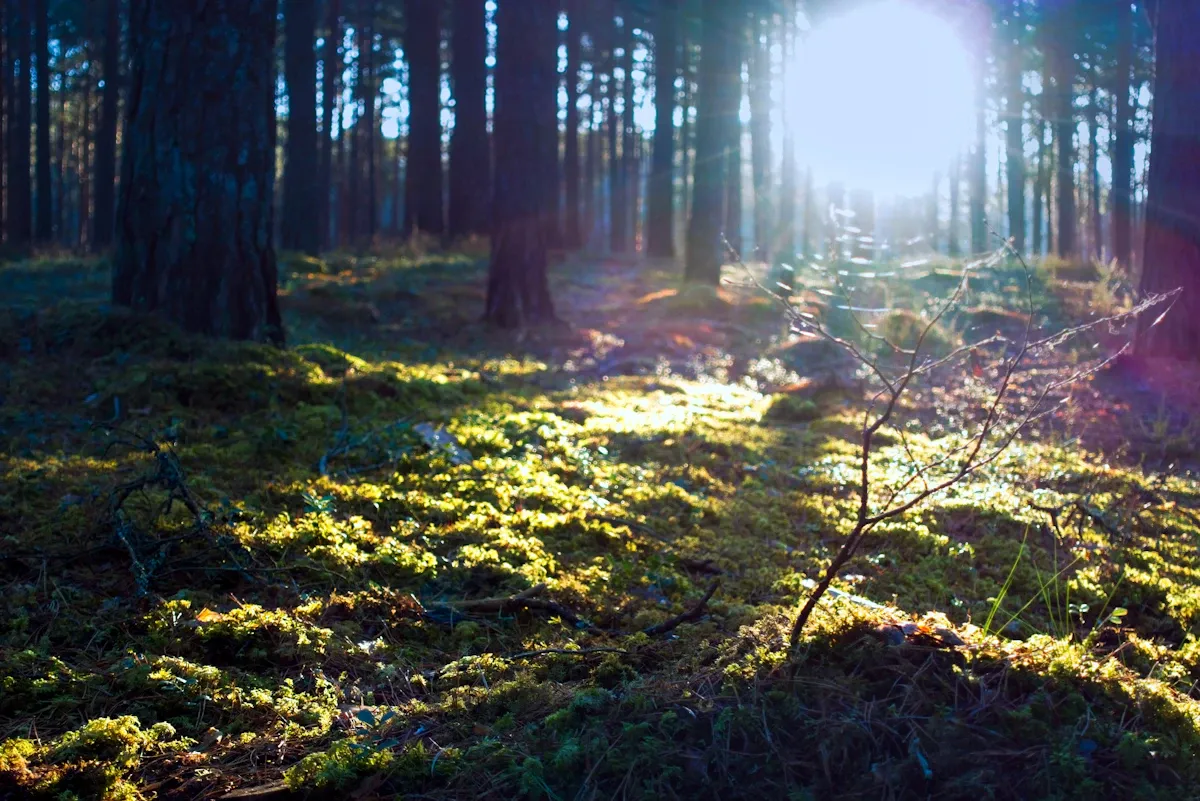
Thirty-five years ago, Japanese researchers officially recognized something rural communities had known for centuries: walking slowly through a forest measurably changes your body chemistry. Today, with chronic stress driving burnout, insomnia, and anxiety to record levels, that old insight is getting serious scientific attention. The practice is called forest bathing, and the research shows it can significantly drop your body's main stress hormone, cortisol.
What Is Forest Bathing and How Does Shinrin-Yoku Work?
Forest bathing, or shinrin-yoku, is not hiking. It is not a workout. It is not about covering distance or reaching a destination.
The Japanese Ministry of Agriculture, Forestry, and Fisheries coined the term in 1982 as part of a national public health program. The idea was simple: encourage people to spend intentional, unhurried time in forested environments for their health, according to research published in the International Journal of Biometeorology.
Think of it as meditation, but with your eyes open and your feet on dirt. You walk slowly. You breathe deeply. You pay attention to the texture of tree bark, the sound of leaves shifting, the smell of damp earth. There is no phone, no playlist, no checklist. The forest itself becomes the therapy.
This matters because your body does not know the difference between a work deadline and a predator. Both trigger the same cortisol response. Cortisol is your primary stress hormone. It raises your blood sugar, tenses your muscles, and puts your brain on high alert. In small doses, that response keeps you alive. When it stays elevated for weeks or months, it damages your sleep, your memory, your mood, and your immune system.
Forest bathing targets that exact chemical pathway. Not through medication, not through willpower, but through sensory immersion in a natural environment.
Why Cortisol Reduction Matters for Mental Clarity
Most people think of stress as a feeling. Anxious thoughts, a tight chest, a short temper. But underneath those feelings is a physical process, and cortisol is the engine driving it.
When cortisol stays high, your prefrontal cortex, the part of your brain responsible for clear thinking and decision-making, actually loses efficiency. You literally cannot think as well when you are chronically stressed. Sustained cortisol elevation has been linked to difficulty concentrating, memory problems, and impaired judgment, according to a 2024 review in Frontiers in Psychology.
So lowering cortisol is not just about feeling relaxed. It is about getting your brain back online. That is where forest bathing shows consistent, measurable results.
A systematic review and meta-analysis published in the International Journal of Biometeorology pooled data from 22 studies, with 8 included in the quantitative meta-analysis. The findings showed that salivary cortisol levels were significantly lower in forest groups compared to urban control groups both before and after the intervention. This was not a small or subjective effect. Researchers measured actual cortisol concentrations in saliva, and in nearly every study, the numbers dropped.
The Frontiers in Psychology review expanded on these findings by specifically looking at stressed populations. It noted that shinrin-yoku interventions showed consistent stress reduction effects across diverse groups, including people with diagnosed stress-related conditions. The effect held up across different forest types, different countries, and different session lengths.
The Sensory Pathway: How Trees Talk to Your Hormones
You might wonder how simply standing near trees changes your hormones. The answer lives in your senses.
When you walk through a forest, your nose picks up phytoncides. These are airborne chemicals that trees and plants release into the air. Conifers like pine and cedar are especially rich in them. Research indicates that inhaling phytoncides boosts immune function by increasing natural killer cell activity, a type of white blood cell that fights infection and tumors.
But phytoncides are just one part of the equation. Your visual system also plays a role. Looking at fractal patterns, the branching structures you see in trees, leaves, and ferns, appears to reduce physiological arousal. Fractals are everywhere in nature but rare in human-built environments. Your brain seems to process them with less effort, which produces a calming effect.
Then there is sound. Birdsong, wind through leaves, running water. These are what acoustic ecologists call biophilic sounds. They activate the parasympathetic nervous system, which is your body's rest-and-digest mode. Compare that to urban noise: traffic, sirens, construction. Those sounds keep your sympathetic nervous system, your fight-or-flight mode, engaged even when nothing is actually threatening you.
Forest bathing works because it engages all these pathways at once. You are not just relaxing your mind. You are feeding your nervous system a completely different set of signals than it gets in your normal environment.
Real-World Impact: From Japan to Your Local Park
The original Japanese forest bathing program designated specific therapeutic forests across the country, with trails designed for slow walking and sensory engagement. Certified guides lead sessions that typically last two to four hours. The practice is now embedded in Japan's preventive healthcare system.
But you do not need a certified guide or a designated therapeutic forest to get benefits. The research suggests that the core ingredients are simple: a green natural setting, slow movement, and open attention to your surroundings.
A 2025 analysis of forest bathing's evolution noted that the practice is being adapted into shorter, more accessible formats for urban populations. Micro-sessions in city parks are showing measurable stress reduction, though longer sessions in denser forests tend to produce stronger effects, according to VitalMindBalance.com. This matters because most people cannot drive to an old-growth forest on a Tuesday afternoon.
Some mental health professionals are now prescribing nature time alongside traditional therapy. Not as a replacement, but as an additional tool. The logic is straightforward: if a patient's cortisol is chronically elevated, talk therapy alone may not be enough. You also need to give the body a break from the stress response itself.
What This Means for Your Routine
Here is what the research does not say. It does not say that one walk in the woods will cure burnout. It does not say forest bathing replaces medication or therapy for serious conditions.
What it does say is that your environment physically shapes your stress chemistry. And that changing your environment, even briefly and even in small ways, can shift that chemistry in a measurable direction.
The most practical takeaway is this: if your cortisol is high, your environment is part of the problem. Your phone notifications, your fluorescent lights, your background noise, your sitting position. All of it sends signals. Forest bathing works because it replaces those signals with ones your nervous system evolved to expect.
You can start small. Find the greenest space you can get to in fifteen minutes. A park, a tree-lined street, even a garden. Walk slowly. Leave your phone in your pocket. Notice five things you can see, four you can hear, three you can feel, two you can smell. Do that once or twice a week and pay attention to how your thinking changes afterward.
The science is clear that nature is not just a nice backdrop for life. It is an active ingredient in mental health. So the real question is: when was the last time you let a forest do its job?
Comments