
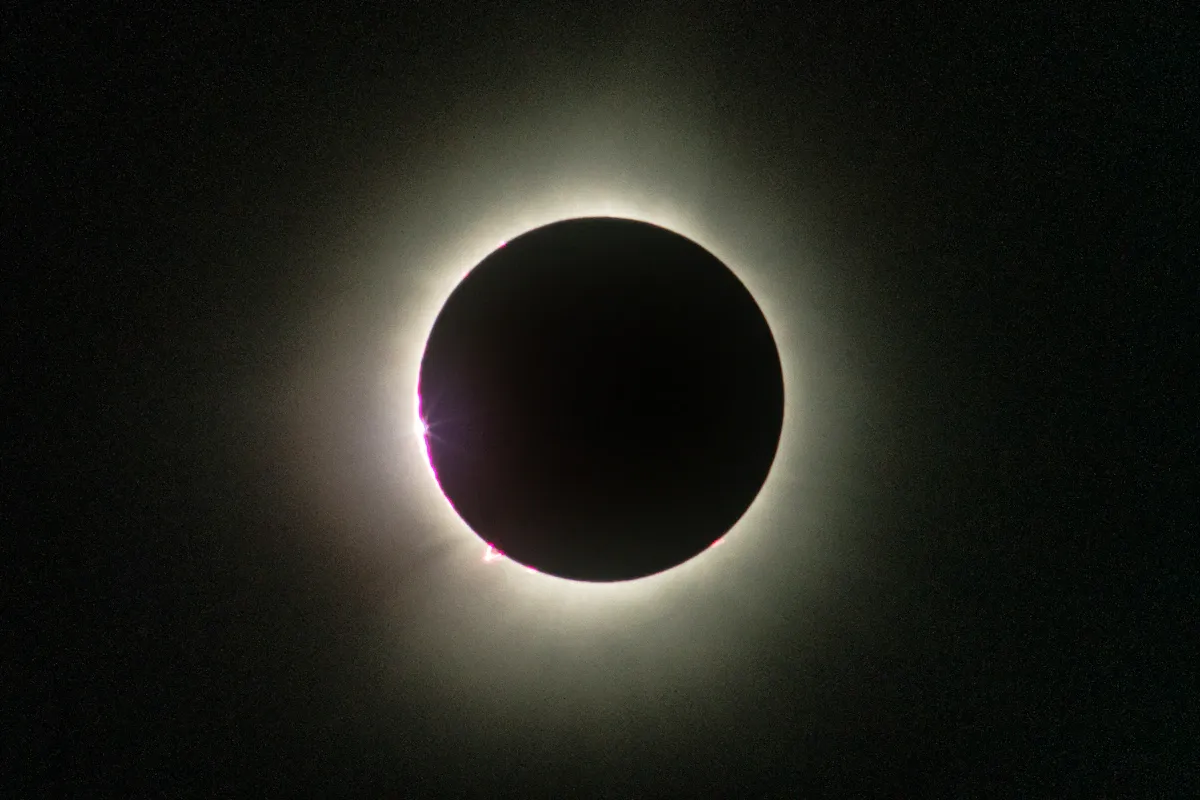
Fifty-six years ago, Apollo 13 astronauts hurtled around the far side of the Moon with no way to see a solar eclipse. On April 6, 2026, NASA's Artemis II crew broke that same distance record and watched a total solar eclipse unfold from deep space, something no human had ever done during a lunar flyby. This was not just a cool photo opportunity. It was a moment that rewrote what we thought was possible for human observation in space.
Artemis II Crew Sees Total Solar Eclipse Beyond the Moon
The four astronauts aboard NASA's Orion spacecraft had already made history earlier that day by traveling farther from Earth than any human since Apollo 13. But the day was far from over. As they approached the Moon on their flyby trajectory, a total solar eclipse crossed their path. The crew was flying nearly 253,000 miles from Earth at the time, having passed within about 4,070 miles of the lunar surface.
From their position just a few thousand miles above the Moon, the astronauts experienced something fundamentally different from any eclipse on Earth. On the ground, totality lasts just a few minutes. Inside Orion, the Moon entirely hid the Sun's disk for roughly 54 to 57 minutes, depending on the source, turning the event into a slow, extended spectacle rather than a fleeting flash.
What makes this particularly striking is the geometry involved. A total solar eclipse happens when the Moon passes directly between the Sun and Earth. But the Artemis II crew was flying past the Moon, not between it and Earth. Because they were so close to the Moon, it appeared large enough in their sky to cover the Sun for nearly an hour. Their line of sight to the eclipse was completely different from anything ground-based observers or even low-Earth orbit astronauts have experienced.
Why This Eclipse Observation Is Unlike Anything Before
Eclipses have been photographed from space before. Astronauts on the International Space Station have captured stunning images of the Moon's shadow on Earth. Satellites like NOAA's Deep Space Climate Observatory have recorded eclipses from a million miles away. But none of those observations involved humans physically present at the scene, watching in real time from beyond the Moon.
The difference matters for several reasons. Human eyes and brains process visual scenes differently than cameras. Astronaut Victor Glover described seeing earthshine illuminating the Moon, calling it 'a black orb' with Earth so bright in the distance. They could see stars normally too faint to photograph near the Moon, because the lunar surface was in darkness. The corona formed a glowing halo around the dark disk, revealing details of the Sun's outer atmosphere typically hidden by its brightness. These qualitative details rarely show up in satellite imagery.
There is also a psychological dimension. These four astronauts were looking back at their home planet while being farther from it than almost anyone in history. Seeing a solar eclipse from that distance, knowing that billions of people below them were experiencing the same celestial event in a completely different way, adds a layer of meaning that no instrument can measure.
The timing also aligns with a broader moment in public astronomy. Total solar eclipses have drawn massive public attention in recent years, and the April 2026 eclipse was widely anticipated across parts of the world. The fact that humans in deep space were watching the same event creates a rare shared experience across enormous distances.
What This Tells Us About the Future of Deep Space Observation
The Artemis II eclipse observation is not just a historic footnote. It points to something bigger about how human spaceflight changes the way we study the universe. Robots and satellites are incredibly capable, but they do not replace the value of having a trained observer on site.
Consider what happened here. The crew did not just passively watch. They actively photographed the event using a Nikon Z9 mirrorless camera they had campaigned to get added to the ship's manifest, along with a Nikon D5 and GoPro HERO4 cameras. They made real-time decisions about camera placement and settings, and could adjust their approach based on what they saw. That kind of adaptive observation is something automated systems still struggle with, especially in unexpected situations.
This also has implications for future Artemis missions. Artemis III aims to land humans on the lunar surface. If that crew happens to be on the Moon during a solar eclipse, the observations could be even more remarkable. Imagine standing on the Moon and watching the Moon's own shadow cross Earth. The scientific data from such an event, combined with human description and photography, would be genuinely unprecedented.
Beyond the Moon, the same principle applies to Mars missions and other deep space destinations. Every time humans travel farther, they carry the ability to observe astronomical phenomena from new angles. Each of these becomes a unique scientific opportunity that only humans in those specific locations can fully exploit.
There is a practical takeaway too. The Artemis II crew's photography during the eclipse tests how well humans can document dynamic astronomical events from a spacecraft moving at thousands of miles per hour. The lessons learned here will shape observation protocols for every deep space mission that follows.
What Comes Next for Artemis II and Beyond
Artemis II is a test flight, not a landing mission. The crew's primary job is to verify that the Orion spacecraft can safely carry humans around the Moon and back. The eclipse observation was not the mission's main objective, but it shows exactly why having humans on test flights matters. They turn routine checkouts into discoveries.
After this flyby, the Artemis II crew will continue their journey back toward Earth. The data from their eclipse photography will be analyzed alongside ground-based observations of the same event. Scientists will compare what the astronauts saw with what was recorded from Earth's surface and from satellites, building a more complete picture of the eclipse than any single perspective could provide.
Looking further ahead, this moment raises an interesting question for mission planners. Should future deep space flights actively schedule around astronomical events? If a solar eclipse, planetary transit, or comet flyby is predictable years in advance, it might make sense to design flight trajectories that maximize observation opportunities. The Artemis II experience suggests the payoff could be significant. Glover himself noted that the April 1 launch date was chosen specifically to make the eclipse encounter possible.
The broader Artemis program continues to build toward its next milestone. Artemis III remains the mission that will return humans to the lunar surface for the first time since Apollo 17 in 1972. Every successful test, including this one, reduces the risk for that landing. And if the stars align, literally, a future lunar crew might find themselves watching an eclipse from the surface of the Moon itself.
On April 6, 2026, four humans looked back at Earth from beyond the Moon and watched a shadow race across their home world. It was a moment that connected deep space exploration to one of the oldest astronomical experiences humans have ever shared. The question now is what else we will see when we send people to places no one has been before. What would you want to watch from deep space if you had the chance?
Comments